
How to Test a Smoke Alarm, How Often, and When to Replace It (2026)
Quick answer: press and hold the test button on every alarm once a month until it sounds; vacuum the vents every six months; replace 9 V batteries once a year (sealed 10-year alarms don't need it); and replace the whole alarm 10 years after the manufacture date printed on the back. In WA, homes being sold or rented need mains-powered alarms under 10 years old in the right positions, and landlords must keep them working. An alarm that doesn't sound on test, chirps with a fresh battery, or is past its date gets replaced, not repaired.
A smoke alarm is the one thing in the house you hope never does its job, which is why most of them are tested when the builder leaves and never again. The test takes thirty seconds a month. This guide covers how to do it properly on hard-wired and battery alarms, what the lights and chirps mean, when an alarm is due for replacement, and what WA requires of owners and landlords.
How to test a smoke alarm (the monthly test)
- Tell the household — it's loud, and interconnected alarms all sound together.
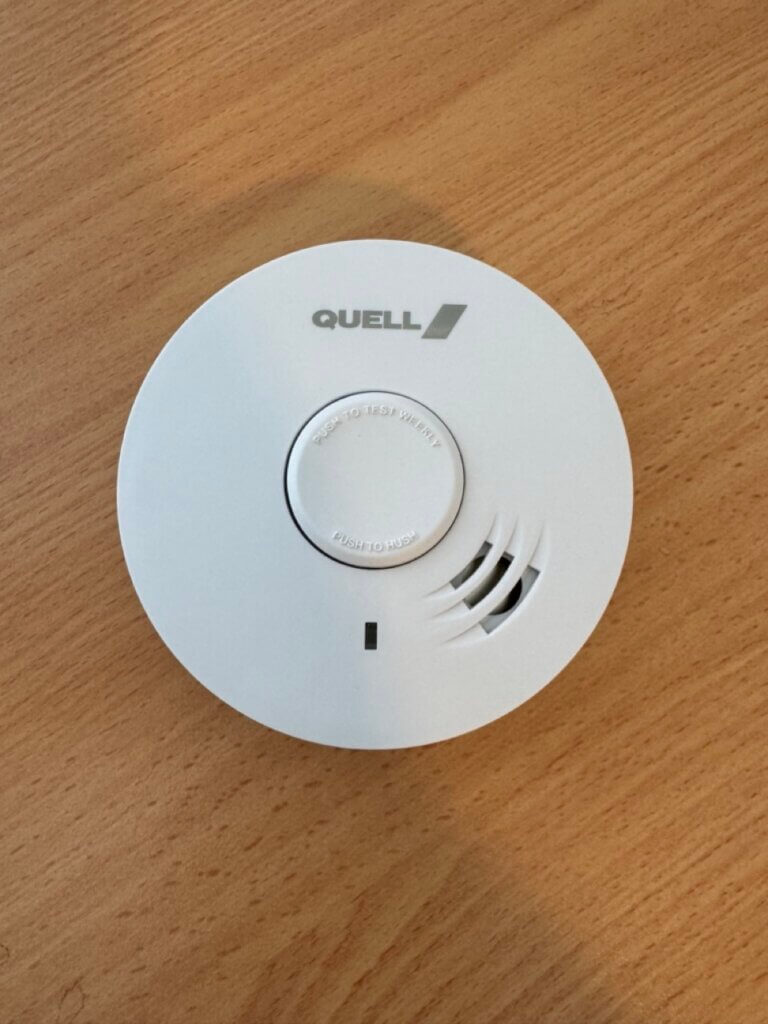
- Press and hold the test button on the alarm (a broom handle works for high ceilings) for a few seconds until it sounds. The button tests the circuitry, the horn and the battery.
- Check interconnection. If the home has more than one alarm and they're interconnected, every alarm should sound when you test one. If only one sounds, the interconnection has failed.
- Listen for the full sound. A weak, warbling or short beep means a tired battery or a failing alarm.
- Check the indicator light — most alarms flash a small green (mains) or red (standby) light every 30–60 seconds; a steady or absent light points to a power problem.
- Note the date — a line on the calendar or a reminder on your phone. Monthly is the standard; the first of the month is easy to remember.
The smoke test (twice a year)
The button proves the alarm can sound; it doesn't prove the sensor can see smoke. Twice a year, use a can of smoke-alarm test spray (hardware stores sell it) held 30–60 cm from the alarm and sprayed for a second or two; the alarm should sound within a few seconds and stop once the smoke clears. Don't use a candle, a match or burning paper under the alarm — it's a fire risk and can contaminate the sensor. If the alarm sounds on the button but not on test smoke, the sensor has failed and the alarm needs replacing.
Need an Electrician in Perth?
BOOK ONLINE TODAY
What the chirps and lights mean
| What you hear or see | What it means | What to do |
|---|---|---|
| Loud continuous or three-beep pattern | Smoke or a fire | Get out, then check |
| One chirp every 30–60 seconds | Low backup battery, or end of life | Replace the battery; if it keeps chirping, check the date |
| Chirp after a power cut or storm | Mains was lost and the backup took over | Should stop when power returns; replace the battery if not |
| Green light flashing or steady | Mains power present (hard-wired alarms) | Normal |
| Red light flashing every 30–60 seconds | Normal standby on most models | Normal |
| No light at all | No mains and a flat battery, or a dead alarm | Check the circuit breaker; replace the alarm if powered |
| Alarms every time someone showers or cooks | Steam or cooking too close, or a dirty sensor | Clean it; relocate it if it's near the bathroom or kitchen door |
Our guide to a beeping hard-wired alarm goes through the fixes in detail.
Maintenance through the year
- Monthly: the button test on every alarm.
- Every six months: vacuum the vents with a soft brush to clear dust and insects — the main cause of false alarms and missed ones — and do the smoke test.
- Yearly: replace 9 V backup batteries in alarms that take them. Sealed 10-year lithium alarms don't need it; the whole unit is replaced at 10 years.
- Every 10 years: replace the alarm. The manufacture date is printed on the back; sensors degrade and the standard treats a 10-year-old alarm as expired.
- After any renovation or painting: check nothing was covered, painted or disconnected.
- Landlords: test at the start of every tenancy and keep a record; replace anything past its date before the tenant moves in.
The WA rules
- Selling, renting or hiring a home: smoke alarms must be mains-powered, less than 10 years old, compliant with AS 3786, and located in every hallway serving bedrooms and on every storey; interconnected where the building permit dates from 1 May 2015 or later. Battery-only alarms are allowed only where wiring is impossible, and then only 10-year sealed units.
- Landlords must keep alarms in working order for the whole tenancy.
- Replacing a hard-wired alarm is electrical work for a licensed electrical contractor (our licence is EC15449); swapping a battery isn't.
Selling or renting soon? Our WA compliance checklist has RCDs, smoke alarms and the certificate together, and our smoke alarm cost guide has 2026 prices.
When to replace rather than test
- The alarm doesn't sound on the button, or doesn't respond to test smoke.
- It chirps with a new battery.
- It's past 10 years from the manufacture date, or the date is missing.
- It's an ionisation alarm — photoelectric alarms respond faster to smouldering fires and are what fire services recommend.
- It's yellowed, cracked, painted over or has been through a fire or a flood.
- It's battery-only and the home is about to be sold or rented.
Replacing a hard-wired alarm is $180–$250 in Perth; a new mains-powered alarm in a new position $250–$350.
How Web X can help
- Smoke alarm testing, replacement and new installs, photoelectric, with 10-year backup batteries.
- RCD and smoke alarm compliance check with certificate for a sale or tenancy: $199 fixed.
- Fixed price, $0 call-out fee, licensed electrical contractor EC15449, 300+ five-star Google reviews. See our smoke alarm service.
We service smoke alarms across the Perth metro — Joondalup, Scarborough, Belmont, Melville, Armadale, Baldivis and everywhere between.
Frequently asked questions
How often should I test my smoke alarm?
Monthly on the button, with a smoke-spray test and a clean every six months. Landlords should test at the start of every tenancy.
How do I test a hard-wired smoke alarm?
The same way — press and hold the test button until it sounds. Hard-wired alarms have a backup battery, so the test also checks that; if it chirps or sounds weak, replace the battery or, if it's sealed, the alarm.
What if my smoke alarm doesn't sound when I press the button?
Check the circuit breaker for a hard-wired alarm and the battery for a battery alarm. If it still doesn't sound, the alarm has failed and needs replacing — a hard-wired one by a licensed electrician.
How long do smoke alarms last?
Ten years from the manufacture date printed on the back, after which the sensor is unreliable and the alarm is treated as expired for a sale or tenancy.
Why does my smoke alarm go off when I shower or cook?
Steam and cooking particles set off alarms placed too close to the bathroom or kitchen. Clean the alarm first; if it keeps happening, it needs relocating a few metres along the hallway.
Do hard-wired smoke alarms need batteries?
Yes — a backup battery for power cuts. Older alarms take a 9 V battery replaced yearly; newer ones have a sealed 10-year battery and the whole alarm is replaced at 10 years.
Can I test the alarm with a candle or a match?
No. Use smoke-alarm test spray. Open flames under an alarm are a fire risk and can contaminate the sensor.
Written by Donny Mobin, licensed electrical contractor (EC15449) and owner of Web X Electricians Perth. Written from the smoke alarm work we do across the Perth metro area; prices are our own 2026 prices, including GST.
Last updated 16 September 2026.
Smoke alarms due for a test or replacement?
Call 0422 117 839 or book online. Fixed price, $0 call-out fee, photoelectric alarms with the certificate included. More on our smoke alarm service.