
How Much Does EV Charger Installation Cost in Perth? (2026 Prices)
Quick answer: in Perth in 2026, a 7 kW single-phase home EV charger costs $1,500 to $2,500 supplied and installed when the switchboard is close to the parking spot. If you supply the charger (a Tesla Wall Connector, for example), installation alone is $700 to $1,300. A 22 kW three-phase charger runs $2,500 to $4,500, and a long or underground cable run to a carport or detached garage adds $400 to $1,500.
These are our own Perth prices, including GST and the Electrical Safety Certificate — not the American "Level 1 / Level 2" figures that most cost guides copy. Fixed price before we start, $0 call-out fee.
Charging at home is the whole point of owning an EV in Perth: you plug in when you get home, and the car is full by morning for a fraction of what public chargers cost. The install itself is a one-day job for a licensed electrician, but the price depends far more on your house than on the charger — where the switchboard is, whether the board can take another 32 A circuit, and whether you're on single-phase or three-phase power.
This guide gives you the real 2026 numbers, explains the Western Power rules that apply in WA, and walks through what happens on the day. Use the estimator for a range for your place, then send us a photo of the switchboard for a fixed quote.
EV charger installation estimator (Perth, 2026)
Pick the options that match your home. The range is what we'd expect to quote before seeing the switchboard; the fixed price comes after a photo or a quick look.
EV charger installation costs in Perth in 2026
These are the jobs we quote most often. Prices include a dedicated circuit from the switchboard, the correct RCD protection, an isolator where required, mounting and commissioning of the charger, testing, and the Electrical Safety Certificate.
| Job | Typical Perth price (2026) | Notes |
|---|---|---|
| 7 kW (32 A) single-phase charger, supplied and installed, short run | $1,500 – $2,500 | The standard home install: garage wall within 10 m of the board |
| Install only — you supply the charger | $700 – $1,300 | Tesla Wall Connector, a charger bundled with the car, or one you bought online |
| 22 kW three-phase charger, supplied and installed | $2,500 – $4,500 | Needs three-phase supply and a car that accepts 11 or 22 kW AC |
| Add: long run (10–25 m) through the roof or along a wall | +$250 – $600 | Cable, conduit, clips and time |
| Add: underground run to a carport, shed or detached garage | +$700 – $1,500 | Trenching, orange conduit, a sub-main or a small sub-board |
| Add: extra RCBO / extension for a full board | +$150 – $350 | Common in 2000s homes where every way is used |
| Add: switchboard upgrade (old fuse board) | +$1,800 – $2,800 | See our switchboard upgrade cost guide |
| Budget option: 15 A power point for a portable charger | $250 – $400 | Around 3.6 kW — fine for a plug-in hybrid or a short daily commute |
The charger itself is roughly half the price of a supplied-and-installed job. A good 7 kW smart charger is $800–$1,500 at trade; a 22 kW three-phase unit is $1,300–$2,500. The rest is a licensed electrician's half-day: the circuit, the protection, the mounting and the paperwork.
Which charger do you actually need?
Almost every EV sold in Australia charges through a Type 2 plug, so the question is speed, not compatibility.
- A 15 A power point (about 3.6 kW). The portable charger that came with the car plugs into it. Adds roughly 20 km of range per hour — plenty for a plug-in hybrid or a 40 km commute, and the cheapest option by a wide margin. Our 15 A power point guide has the details. A standard 10 A point works too, but slowly (about 2.4 kW) and it shouldn't be an extension lead.
- A 7 kW single-phase wall charger (32 A). The right answer for most Perth homes. Adds about 40 km of range per hour, so an empty battery is full overnight, and it fits inside Western Power's standard single-phase connection without an upgrade. Smart models schedule charging for cheap tariff windows and can divert your solar.
- An 11–22 kW three-phase charger. Only worth it if you already have three-phase power (or are upgrading anyway) and your car accepts 11 kW or 22 kW AC — many EVs are limited to 7–11 kW on AC regardless of the charger. Useful for two EVs, a work vehicle that needs a fast turnaround, or a workshop. See our three-phase power page.
DC fast chargers (the 50–350 kW units at shopping centres and along the highway) are commercial equipment costing tens of thousands, and they're not what goes in a house.
Need an Electrician in Perth?
BOOK ONLINE TODAY
What's actually done on the day
A standard 7 kW install takes three to five hours. Here's the sequence:
- Check the supply and the switchboard. We confirm single- or three-phase, the main switch rating, spare ways and the maximum demand of the house — a 32 A charger is one of the biggest loads a home can have, and the Wiring Rules require the calculation.
- Run a dedicated circuit. 6 mm² cable (or larger for long runs) from the switchboard to the charging point, in conduit where it's exposed, through the roof space or underground where it isn't.
- Fit the protection. A dedicated RCBO sized for the charger, with the RCD type EV charging requires — Type A with 6 mA DC fault detection built into the charger, or a Type B RCD where it isn't. This is the item cheap installs get wrong.
- Mount and wire the charger. On a wall or a post, at a height that suits the cable and the car's charge port, with an isolator next to it where required.
- Commission and test. Earth continuity, insulation resistance, polarity and an RCD trip test; then a live charging session with your car to check the charge rate.
- Set up the app. Tariff schedule (charge in the cheap window), solar diversion if you have panels, and load management if the house is near its supply limit.
- Paperwork. A notice to Western Power where required, and your Electrical Safety Certificate within 28 days.
Western Power and the WA rules that apply
- Your standard connection is 63 A single-phase, or 32 A per phase three-phase. Western Power's guidance for EV charging says a 7 kW single-phase charger is permitted on a standard connection, single- or three-phase, provided the home's maximum demand stays within the limit. Our job is to do that calculation, not to guess.
- If the house is already near its limit — ducted aircon, an induction cooktop, a pool and electric hot water on one phase — there are two options: apply to Western Power for an upgraded connection, or install a smart charger with import limiting so the charger throttles when the rest of the house is drawing hard. The second is usually cheaper and faster.
- The main switch must be a circuit breaker. Older boards with a plain main switch or fuses need that changed for an EV charger connection. Often it's the trigger for a switchboard upgrade.
- Dedicated circuit and correct RCD protection under AS/NZS 3000:2018 — no sharing the garage power-point circuit.
- Licensed contractor only. EV charger installation is electrical work and can only be done by a licensed electrical contractor (our licence is EC15449). Anything sold as "plug and play" still needs the circuit and the point installed by one.
- Electrical Safety Certificate within 28 days of completion, and a notice to Western Power where the work is notifiable.
- Three-phase upgrades go through a Western Power connection application; allow several weeks and budget for their charges on top of the electrical work.
What pushes the price up (or down)
- Distance from the switchboard. The single biggest variable. A meter box on the garage wall is a short job; a board on the far side of the house with the car in a carport out front is a long one.
- Underground runs. A detached garage, shed or carport means trenching, conduit and sometimes a small sub-board.
- The switchboard. Spare way and modern protection: no extra cost. Full board: an extension or a couple of RCBOs. Fuse board: it needs upgrading first, and you'd want that done anyway.
- Single-phase vs three-phase. Three-phase chargers cost more, need heavier cable, and if you don't have three-phase yet, Western Power's upgrade is a separate project.
- The charger you choose. A tethered smart charger with solar diversion costs more than a basic socket-only unit, and is worth it if you have panels.
- Post or pedestal mounting. No wall near the car means a post, a footing and the extra cable to reach it.
- Strata and apartments. Body-corporate approval, metering to your lot, cable runs through common property and load management for the building all add time. Get the strata's written approval before you buy a charger.
Chargers we install
We'll install any charger that's certified for Australia and fit for your supply, and we can supply one. The units we see most in Perth homes:
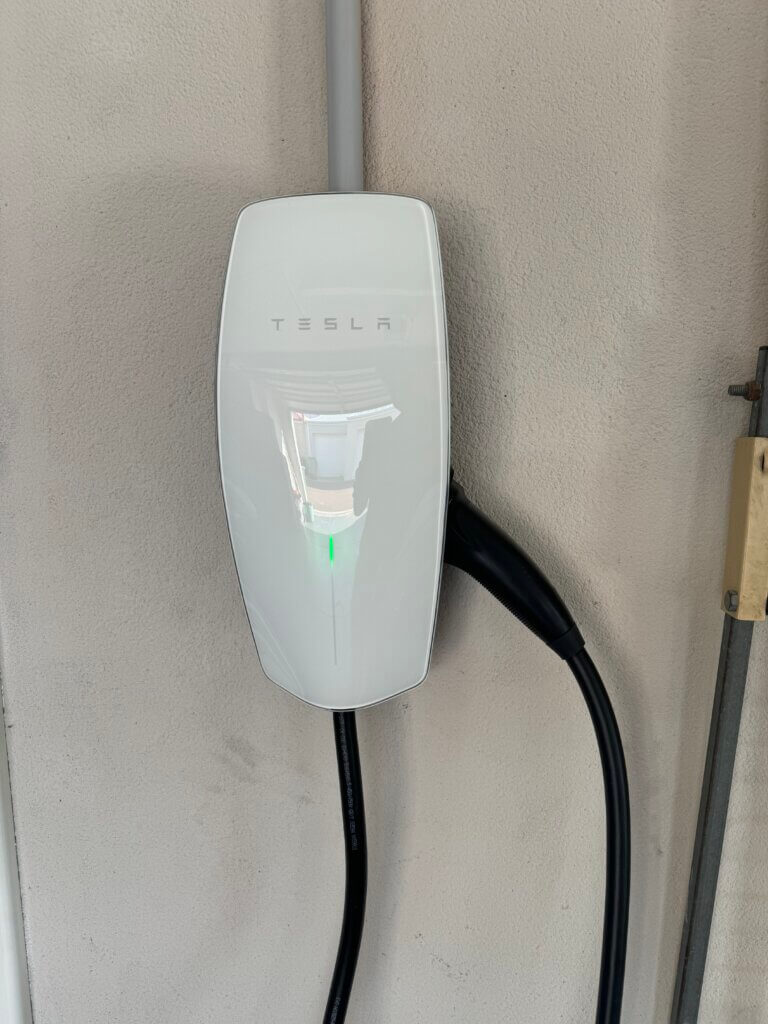
- Tesla Wall Connector — 7 kW single-phase or up to 22 kW three-phase, tethered Type 2 cable, works with any EV, not just Teslas.
- myenergi Zappi — the pick for solar homes: charges from excess solar only, or tops up from the grid on a schedule.
- Fronius Wattpilot — pairs with Fronius solar inverters for solar-aware charging; single- and three-phase models.
- Wallbox Pulsar Plus — compact, app-controlled, with built-in load management.
- Ocular, Delta, Schneider EVlink and ABB Terra — solid socket-only or tethered units for homes and small businesses.
Whatever the brand, we fit it with the right RCD type and a dedicated circuit — the charger is only as safe as the circuit behind it.
Solar, batteries and Synergy's EV tariff
Perth has some of the highest rooftop-solar uptake in the world, and an EV is the best battery most of those homes will ever own. A solar-aware charger (Zappi, Wattpilot, or a Wallbox with a power meter) diverts your excess solar into the car during the day instead of exporting it for a few cents.
If you're out during the day, Synergy's EV add-on plan gives a cheaper "super off-peak" window in the middle of the day and a higher rate in the evening peak — check the current rates on Synergy's site before you decide. A smart charger schedules around whichever tariff you're on.
A home battery changes little for the charger itself — you wouldn't normally charge a car from a house battery — but the switchboard has to have room for both, which is another reason to plan them together.
Rebates and incentives in WA (2026)
Straight answer: there's no WA Government rebate for a home EV charger in 2026. The state's $3,500 Zero Emission Vehicle rebate closed to new purchases on 10 May 2025, and the Charge Up grants co-funded chargers for businesses, not-for-profits and councils, not households. What's left is the running-cost saving — charging at home costs a fraction of petrol — and, for some people, a novated lease that bundles the charger. If you're installing for a business or a strata scheme, ask us; grant rounds come and go and we'll tell you what's open.
How Web X quotes an EV charger install
Send us a photo of the open switchboard, a photo of where the car parks, and a rough distance between the two — that's usually enough for a fixed quote the same day. If you already have a charger, tell us the model.
- Fixed price before we start, $0 call-out fee.
- Most installs are done in one visit, usually within a week of the quote.
- Every job includes the dedicated circuit, correct RCD protection, testing, app setup and the Electrical Safety Certificate.
- Licensed electrical contractor EC15449, 300+ five-star Google reviews. See our EV charger installation service.
We install chargers across the Perth metro, from Joondalup and Scarborough to Canning Vale, Baldivis and out through Ellenbrook and the Swan Valley.
Ways to keep the cost down
- Put the charger near the board. If the car can park on the meter-box side of the house, the run is short and the price drops.
- Don't over-buy. A 7 kW charger fills any car overnight. 22 kW only pays if your car takes it and you need fast turnarounds.
- Ask about a 15 A point first if you drive under 50 km a day or own a plug-in hybrid.
- Bundle it with a switchboard upgrade if the board is due anyway — the EV circuit is cheap while the board is open.
- Buy the charger with the car if the dealer bundles one, then pay for install only.
- Get strata approval before buying so you don't own a charger you can't fit.
Frequently asked questions
How long does EV charger installation take?
Three to five hours for a standard 7 kW install with a short cable run. Long or underground runs, post mounting or a switchboard upgrade can take the day.
Can I install an EV charger myself?
No. In WA, wiring a charger is electrical work that can only be done by a licensed electrical contractor, and a DIY install can void your home insurance and the charger's warranty. Plug-in chargers still need a properly installed 10 A or 15 A power point on a suitable circuit.
Do I need three-phase power for an EV charger?
No. A 7 kW single-phase charger is what most Perth homes install, and it's permitted on a standard Western Power connection. Three-phase only matters if you want 11–22 kW charging and your car supports it.
Will Western Power need to approve my charger?
For a 7 kW charger on a standard connection, no application is needed, but your electrician must confirm the house's maximum demand stays within the connection limit and lodge the required notice. If the home is near its limit, a smart charger with import limiting or a connection upgrade is required.
Can I charge from solar?
Yes, with a solar-aware charger such as a Zappi or Wattpilot, or a Wallbox with a power meter. It measures what you're exporting and feeds that into the car, topping up from the grid only when you tell it to.
Is there a rebate for home EV chargers in WA?
Not for households in 2026. The WA vehicle rebate closed in May 2025 and the Charge Up grants were for organisations. Home charging still costs a fraction of petrol, which is the real saving.
Can I get a charger in a strata apartment?
Often, yes, but you need the strata's written approval first, and the install usually involves metering to your lot, a cable through common property and load management for the building. It costs more than a house install; we can quote it once the strata has agreed.
Written by Donny Mobin, licensed electrical contractor (EC15449) and owner of Web X Electricians Perth. Prices in this guide are from our own EV charger quotes and installs across the Perth metro area in 2026, including GST.
Last updated 16 September 2026.
Ready for an EV charger quote in Perth?
Send a photo of your switchboard and your parking spot, or call 0422 117 839. Fixed price, $0 call-out fee, correct RCD protection and the certificate included. You can also request a free quote online or read about our EV charger installation service.